
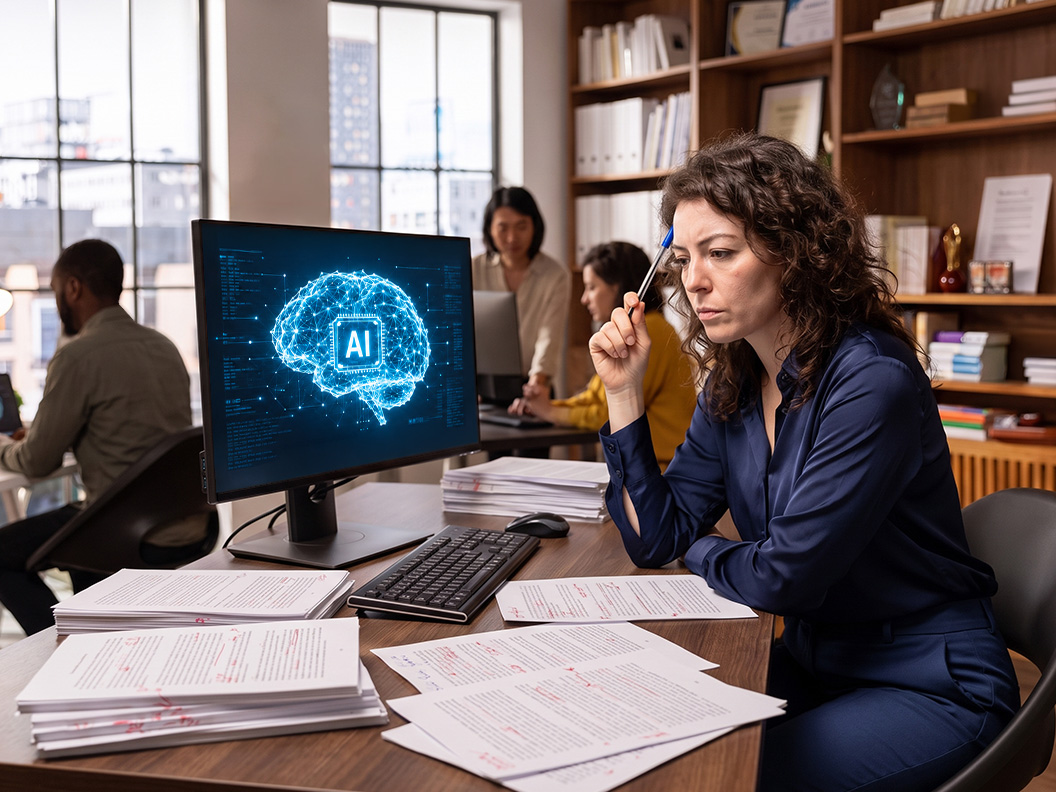
Artificial intelligence has already become part of working with texts: it helps to identify errors, shorten materials, suggest wording and process large amounts of information more quickly. But does this mean that editors will soon no longer be needed? In reality, AI is more likely to change the profession than replace it.
How editors use artificial intelligence
AI can take on some routine tasks. For example, it can help to identify repetitions, check the structure of a text, suggest a shorter version of a paragraph or generate several headline options.
This allows an editor to work with material more quickly and devote more attention to the content, logic and quality of the text.
At the same time, the result suggested by artificial intelligence should not be treated as ready for publication. Any text requires human review.
What AI cannot yet replace
Editing is not only about correcting grammar. An editor must understand the context, target audience, company style and the purpose of a particular piece of content.
AI can suggest a grammatically correct text, but it is not always able to determine whether it sounds natural, whether it accurately conveys the author’s idea and whether it matches the tone of communication.
Fact-checking also remains particularly important. Artificial intelligence can make mistakes, add inaccurate facts or confidently present information that does not correspond to reality. Therefore, responsibility for the final material remains with the editor.
Which skills are becoming more important
With the emergence of AI, the requirements for editors are not disappearing but changing. Today, it is important not only to have a strong command of language, but also to know how to work with new digital tools.
Critical thinking, attentiveness, fact-checking and the ability to assess the quality of the result obtained are becoming especially important. An editor also needs to understand when AI genuinely saves time and when it is simpler and more reliable to complete the task independently.
Can AI replace an editor
Completely – unlikely. Artificial intelligence works well as a tool, but it does not take responsibility for the result and does not always understand context in the same way a person does.
Therefore, the most effective model is one in which AI helps to automate part of the work, while the editor makes the final decisions, checks the facts and is responsible for the quality of the material.
For a modern specialist, it is important not to compete with artificial intelligence, but to learn to use it where it genuinely helps them work faster and more effectively.
AI in an editor’s work is neither an enemy nor a complete replacement for a specialist. It is a tool that can simplify routine processes, but professional judgement, a sense of language and responsibility for the final result remain with the person.
Want to develop in the field of editing and work with modern tools? View the open vacancies at Scientific Alliance.
